Marco Moster
Every operations manager setting up a new call center eventually hits the same wall: which CTI do I go with? The thread on this topic never ends. Genesys or Amazon Connect? Five9 or Aircall? Dialpad or Vonage? Native or open CTI? The debate is real and the stakes feel high. But after the choice is made, a new and quieter problem takes its place -one that no CTI solves on its own.
Every operations manager setting up a new call center eventually hits the same wall: which CTI do I go with? The thread on this topic never ends. Genesys or Amazon Connect? Five9 or Aircall? Dialpad or Vonage? Native or open CTI?
The debate is real and the stakes feel high. But after the choice is made, a new and quieter problem takes its place — one that no CTI solves on its own.
The CTI question everyone is asking
A common scenario in sales operations communities: a company doing a lot of cold calls, a new floor, pressure to scale fast, and a leader trying to figure out which telephony setup will give them the advanced metrics and reporting they need to see how each team performs.
The responses are always a mix: Amazon Connect if you want capability and can handle complexity. Five9 if outbound is your core motion. Vonage or Dialpad if you want something simpler to get off the ground. Genesys if you're already deep in Salesforce and need presence sync across channels.
The honest answer, as one experienced solution architect put it: if you are heavy Salesforce users and care about analytics, it's worth looking into your options carefully. Because they are not all the same — and once volume increases, the differences in how each tool logs missed calls, presence status, and rep-level reporting start to matter a lot.
The gap nobody talks about in the CTI thread
Here's what the debate usually misses: a CTI logs what happened on a call. It tells you a call took place, how long it lasted, whether it was answered, and which agent handled it.
What it does not tell you is what was said.
And for any team that cares about performance — not just activity — that's the gap that compounds over time. You can see that your agents made 7,000 calls this week. You cannot see whether they were misleading clients, ignoring objections, making promises outside your compliance guidelines, or handling vulnerable customers the way your standards require.
That's not a CTI problem. Every CTI on the market has the same limitation. The conversation data is there. Turning it into performance insight is a different layer entirely.
What "advanced metrics and reporting" actually means at scale
When someone asks for advanced metrics and reports to see how each call center performs, they usually mean one of two things:
CTI tools are genuinely good at the first. For the second, you need something that reads the conversation itself — across every call, not just the ones your QA team happens to sample this week.
This is where most teams hit the same wall described in the 97% problem: you're running hundreds or thousands of calls a day, your QA team is reviewing a small fraction of them, and the patterns that matter — the ones that show up in chargebacks, client complaints, and compliance reviews — are forming in the calls nobody reviewed.
The two layers every call center actually needs
Think of it as infrastructure and intelligence.
Infrastructure is your CTI. It routes calls, logs activity, syncs with your CRM, and gives your agents a place to work. This is where the Genesys vs. Amazon Connect conversation lives. Choose well — integration stability, presence sync reliability, and logging accuracy matter more than most people realise until they're debugging a broken presence status at 3,000 agents.
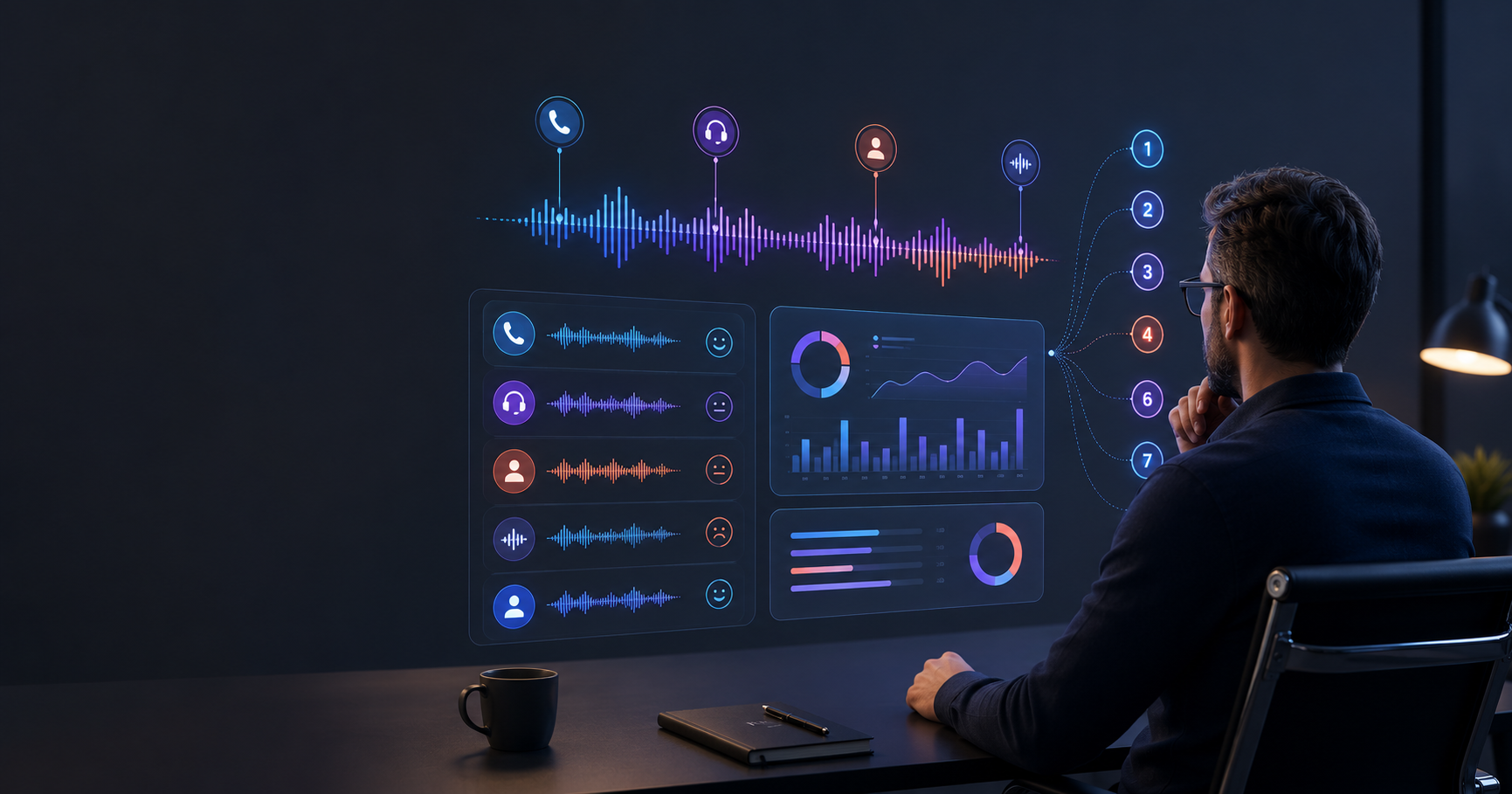
Intelligence is what sits on top. It reads the conversations your CTI captures, scores them automatically, surfaces the red flags your QA team would never physically reach, and gives managers the data they need to coach with precision rather than instinct.
Neither layer replaces the other. A great CTI with no conversation intelligence means you have perfect call logs and no idea what's in them. Conversation intelligence without a stable CTI means the raw data coming in is unreliable.
What this looks like when it works
When both layers are in place, the workflow changes significantly.
Operations managers stop asking "which 200 calls should we review this week?" and start asking "which agents need attention this week, and why?" The answer comes from data — every call scored automatically, every pattern visible, every outlier surfaced before a client complains.
QA teams stop spending their time listening to random samples and start doing what they were actually hired for: coaching agents, designing training that addresses real gaps, and protecting the business from the behaviors that lead to chargebacks and compliance breaches.
And when you're running a multilingual floor — which most growing call centers are — language stops being a structural limitation on what you can review. Every call, in every language, evaluated against the same standards.
So which CTI should you go with?
The honest answer: it depends on your use case, your Salesforce depth, your volume, and your budget — and the experienced voices are right that Amazon Connect is the most capable for complex outbound operations, while simpler options like Aircall or Dialpad are faster to get off the ground.
But whichever you pick, the CTI is the beginning of the conversation, not the end. The metric that matters most isn't which calls were made. It's what happened inside them.
That's the layer that turns a call center into a performance engine.
You want to elevate your call centre using AI?
Schedule a demo for Robonote
If you want to be a part of changing the way we work using AI, join us!
See our open roles here, we are hiring.
Read relevant article about AI, Robonote and our Founders. You can also find more article on our blog
Robonote is the AI sidekick that helps your team unlock the potential of your data. Start your journey today.